
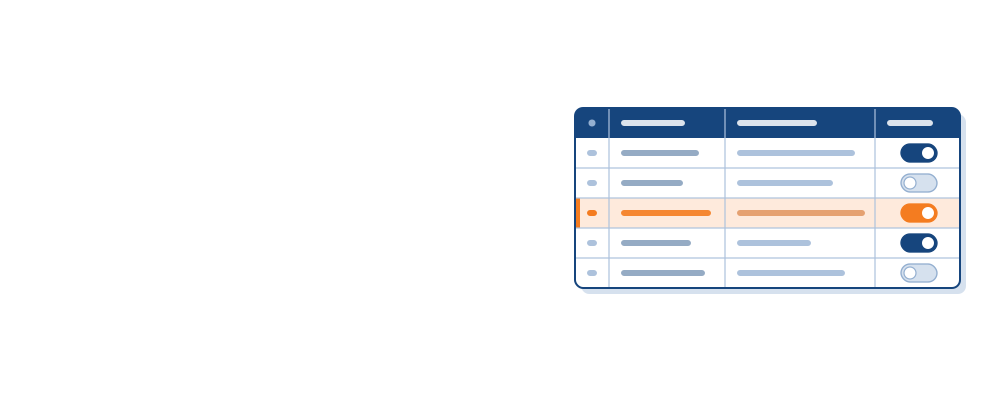
What the SoA must contain
Clause 6.1.3 d) asks for four things for every Annex A control:
- Whether the control is included or excluded
- The justification for including it (a risk, a legal or contractual requirement, or business need)
- The justification for excluding it
- Whether it is implemented
The SoA also covers the necessary controls you've chosen that aren't in Annex A, so the document reflects your whole control set. Most SoAs also add a short description of how each control is met and where the evidence lives. That makes the audit faster and the document far more useful to you. ISO/IEC 27002 gives the implementation guidance for each control; see ISO 27001 vs ISO 27002.
Where the SoA fits
The SoA is an output, not a starting point. It comes at the end of a chain: you set the scope, assess the risks, decide how to treat each one, work out which controls those treatments need, and only then compare your list against the 93 controls in Annex A. Writing the SoA first, by going down Annex A and ticking “yes”, is the most common reason the link to risk is missing.
The SoA and the risk treatment plan are produced together and are easy to confuse:
| Statement of Applicability | Risk treatment plan | |
|---|---|---|
| Organised by | Control | Risk |
| Answers | Which controls apply, why, and are they in place? | What will we do about each risk, who owns it and by when? |
| Covers | All 93 Annex A controls plus any you add | Risks above your acceptance level, plus accepted residual risk |
| Approved by | Top management or delegated owners | Risk owners, who also accept the residual risk |
| Changes when | Controls, scope or obligations change | Actions complete or new risks appear |
The two should reference each other: a risk ID in the SoA's justification, a control number in the treatment plan's actions.
How to build an SoA, step by step
- Settle the scope. Controls are judged against what's in scope. A scope change later means revisiting the SoA.
- Complete the risk assessment and treatment decisions. Each risk you treat by adding controls names the controls it needs.
- Add your obligations. Privacy Act duties, customer contracts, tender conditions and insurer requirements can make a control necessary regardless of risk scores.
- Walk all 93 controls. For each one, decide include or exclude. Annex A is your check that nothing necessary has been missed.
- Write the justification. One or two specific sentences per control, citing risk IDs, obligations or the situation that makes it irrelevant.
- Set the implementation status honestly. Anything not fully implemented goes into the risk treatment plan with an owner and date.
- Point to the evidence. Name the policy, system or record that shows the control operating.
- Approve and version it. Record who approved it and when, and set a review date.
Steps 2 and 5 are where most self-written SoAs go wrong, and they're the part we take on for clients in our ISO 27001 implementation.
A simple SoA layout
| Control | Applies? | Reason | Status | How it's met |
|---|---|---|---|---|
| 5.15 Access control | Yes | Risk R-04; customer contracts | Implemented | Access policy; SSO; quarterly access reviews |
| 7.3 Securing offices | No | Fully remote, no premises in scope | n/a | n/a |
| 8.28 Secure coding | Yes | Risk R-11; we build a SaaS product | In progress | Secure SDLC standard; code review; dependency scanning |
Useful optional columns: a control owner, the evidence location, the date last reviewed, and a mapping to other frameworks you report on, such as SOC 2 criteria or the Essential Eight. A spreadsheet or a compliance platform both work; the auditor cares about the content, not the format.
Writing justifications that hold up
The justification is what the auditor reads most closely. It should be specific enough that someone outside the business could see why the decision makes sense.
| Control | Weak | Stronger |
|---|---|---|
| 5.7 Threat intelligence | Required by ISO 27001 | Risks R-02 and R-06 (phishing, ransomware); we subscribe to ASD alerts and review them monthly |
| 7.4 Physical security monitoring | N/A | No premises in scope; all staff work from home and systems are hosted with certified cloud providers assessed under 5.19–5.23 |
| 8.11 Data masking | Not needed | Included: production personal information must not be used in testing (risk R-09, Privacy Act APP 11); masked data sets used in staging |
| 8.30 Outsourced development | N/A, no outsourcing | Excluded: all development is done by employees; reviewed if we engage contractors |
Good sources of justification are a risk in your register, a law or regulation, a contract or tender clause, or a clear business requirement. “Best practice” on its own is thin. If you exclude a control, say what fact about your business makes it irrelevant, and what would make you revisit it.
How much detail to include
An SoA for a small business is usually a single table of a hundred or so rows: the 93 Annex A controls plus any you've added. Each row needs enough detail for the auditor to know what to test and where to look, and no more. A sentence of justification and a line on how the control is met is typical. Long paragraphs copied from ISO 27002 make the document harder to maintain and commit you to things you may not do; the auditor tests whatever you wrote.
Controls beyond Annex A
Your risk treatment may need controls Annex A doesn't name, such as a specific customer requirement or a sector rule. List them in the SoA too, with the same justification and status, so the document reflects your whole control set. Cloud and SaaS businesses that extend their certificate to ISO/IEC 27017 or ISO/IEC 27018 add those standards' extra controls in the same way. If you report against other frameworks, a mapping column lets one SoA show how each control supports them, which saves duplicating the work for a SOC 2 report or an Essential Eight assessment.
Implementation status
Keep the status values few and defined. A practical set is implemented, partially implemented, planned and not applicable. Don't mark a control implemented until it is operating and leaving evidence; a policy written yesterday is not an implemented control. Partially implemented and planned controls must appear in the risk treatment plan with an owner and target date. Before Stage 2, aim to have every included control at least operating, and be ready to explain anything that isn't.
How auditors use your SoA
- Stage 1. The auditor reads the SoA alongside your scope and risk register to check the link to risk, the quality of exclusions and whether the ISMS is ready for Stage 2.
- Stage 2. The SoA becomes the audit plan. Included controls are sampled for evidence, and staff are interviewed about the ones that affect their work. See Stage 1 and Stage 2 audits explained.
- Surveillance audits. The auditor checks what's changed since last year and samples a different part of the control set.
Mistakes auditors flag
- Weak exclusions. “Not applicable” with no reason, or excluding a control because it's hard.
- No link to risk. Controls included “because they're in Annex A” rather than because of a risk or obligation.
- Wrong status. Marking a control implemented when the evidence doesn't exist yet.
- Out of date. The SoA says one thing and the risk register or policies say another.
- Old control numbers. An SoA still built on the 2013 edition's 114 controls.
- Supplier controls excluded. Treating “our cloud provider does it” as a reason to exclude, rather than as the way the control is met.
- Scope mismatch. Controls justified by systems, sites or teams that sit outside the certified scope, or in-scope systems missing from the SoA entirely.
Sharing the SoA with customers
Enterprise and government buyers increasingly ask for the SoA alongside the certificate, because the certificate alone doesn't show which controls are in place. Keep a customer-facing version that drops internal evidence locations and system names, and share it under NDA. A clear SoA answers a large share of a typical security questionnaire before it's sent.
Keeping it alive
Review the SoA whenever your risk assessment changes, at least annually, and before each surveillance audit. Typical triggers are a new product, a new key supplier, a move to new infrastructure or a scope change. A compliance platform can keep the control status current automatically, but the justifications still need human judgement.
Our internal audit checks the SoA against what's really happening. For the control list itself, see Annex A controls explained; for every other document the standard requires, ISO 27001 required documents and records; and for where the SoA sits in the whole project, how to implement ISO 27001. To have your SoA reviewed before audit, book a free 30-minute consultation.